

Optimal Transport Theory and its Applications
Toshiaki YACHIMURA
Degree: Ph.D (Information Sciences)(Tohoku University)
Research interests: Optimal transport theory, shape analysis, single-cell data analysis
I study optimal transport theory and its applications. Optimal transport matches one distribution to another at minimum transport cost, providing a distance between them and an optimal matching.
Data such as point clouds and histograms can be treated as probability distributions. So, optimal transport distances and matchings are widely used in several areas, for instance, graphics, natural language processing, life sciences, and machine learning. I study their mathematical properties and develop applications in shape and biological data analysis.
(1) Landscape of Many Shapes
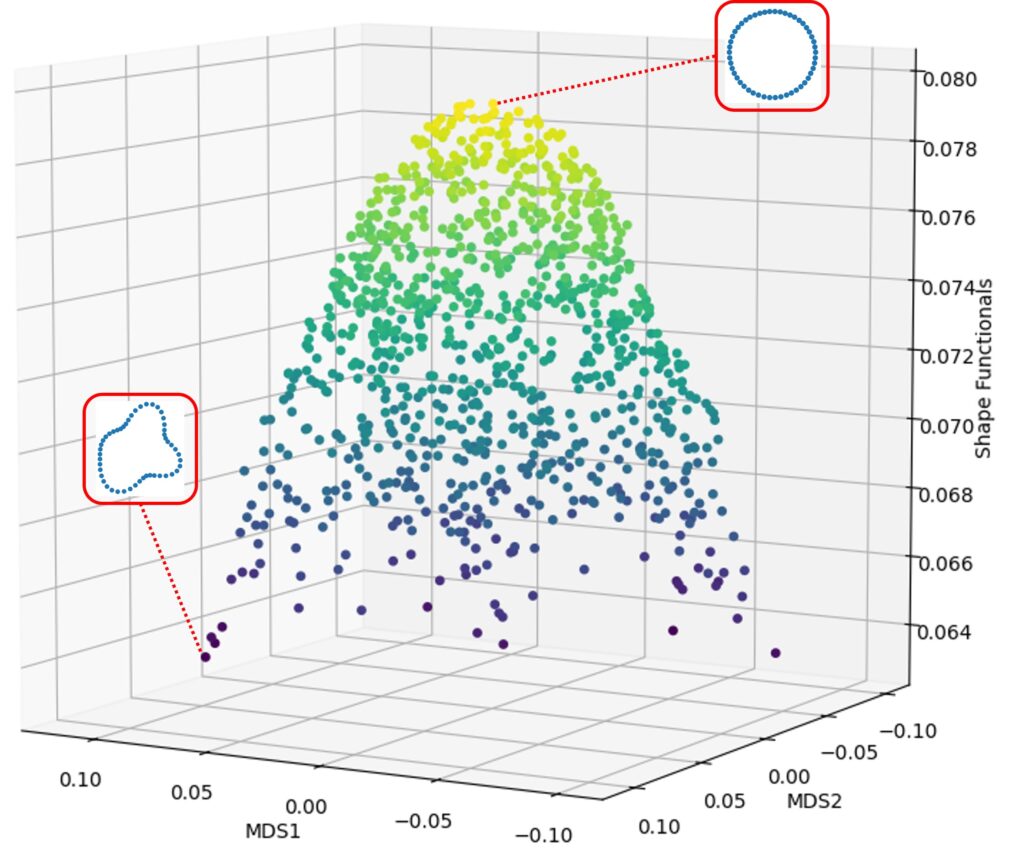
Our Sinkhorn MDS method represents shape boundaries as point clouds and places similar shapes nearby using optimal transport distances. Adding measures of shape, such as area or energy, as height creates a landscape of peaks and valleys.
Fig. 1 addresses the isoperimetric problem: which shape maximizes area at fixed perimeter? Using area as height produces a paraboloid-like landscape whose peak is the circle, the known optimum. This visualization connects to shape optimization, the search for the best shape, with potential applications in design and manufacturing.
(2) Reconstructing Cell Differentiation Dynamics from Single-Cell Data Snapshots via Optimal Transport
Measurement advances allow gene expression to be quantified in individual cells. Because these measurements destroy cells, the same cell cannot be followed over time. Only snapshots of populations are obtained. Reconstructing cell differentiation dynamics from these snapshots is therefore a key challenge.
Our software scEGOT approximates each cell population in time-series single-cell data by a Gaussian mixture and connects these distributions using entropic Gaussian mixture optimal transport to infer differentiation dynamics (Fig. 2). We established mathematical properties of this transport and applied them to biological data. The method infers not only the cell state graph but also differentiation states and velocities at unobserved times. It also infers the underlying differentiation landscape and the gene regulatory relationships that shape it.
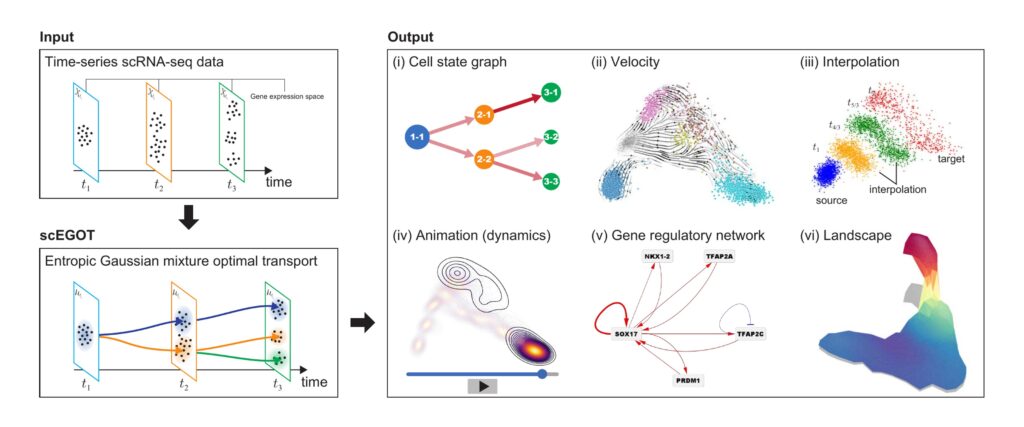
Applied to time-series single-cell data from a system for inducing human induced pluripotent stem (iPS) cells to differentiate into human primordial germ cell-like cells, scEGOT identified differentiation pathways, progenitor populations, and candidate genes important for differentiation.