
Machine Learning Methods for Physical Modeling and Simulation

Takaharu YAGUCHI
Degree: Ph.D. (Information Science and Technology) (University of Tokyo)
Research interests: Scientific Machine Learning, Scientific Computation, Physics-Informed Neural Networks, Operator Learning, Geometric Mechanics, Symplectic Geometry
Since around 2020, the research field known as Scientific Machine Learning (SciML) has been gaining attention. In this research field, methods that combine integrate scientific computing with machine learning techniques are being developed. Specifically, machine learning methods for physical modeling and physical simulation are primarily being developed; For example, methods for deriving differential equations that describe observational data and for accelerating physical simulations are being studied. Specific methods include simulation techniques such as Physics-Informed Neural Networks and operator learning, physical modeling techniques such as Neural ODEs and Hamiltonian Neural Networks, Dynamic Mode Decompositions and the Koopman operator, and methods for deriving interpretable mathematical models, such as SINDy and Kolmogorov-Arnold Networks.
On the other hand, compared to conventional numerical simulation methods, concerns regarding the reliability of these approaches remain. We are working on the development and theoretical analysis of highly reliable machine learning models for physical modeling and simulation. In particular, prediction results of machine learning methods often fail to satisfy physical laws, such as the energy conservation law. Consequently, the predicted results may diverge or decay unnaturally. Thus, methods that preserve physical laws are preferable.
We are developing such methods based on the observation that, in many differential equations, physical laws including the law of
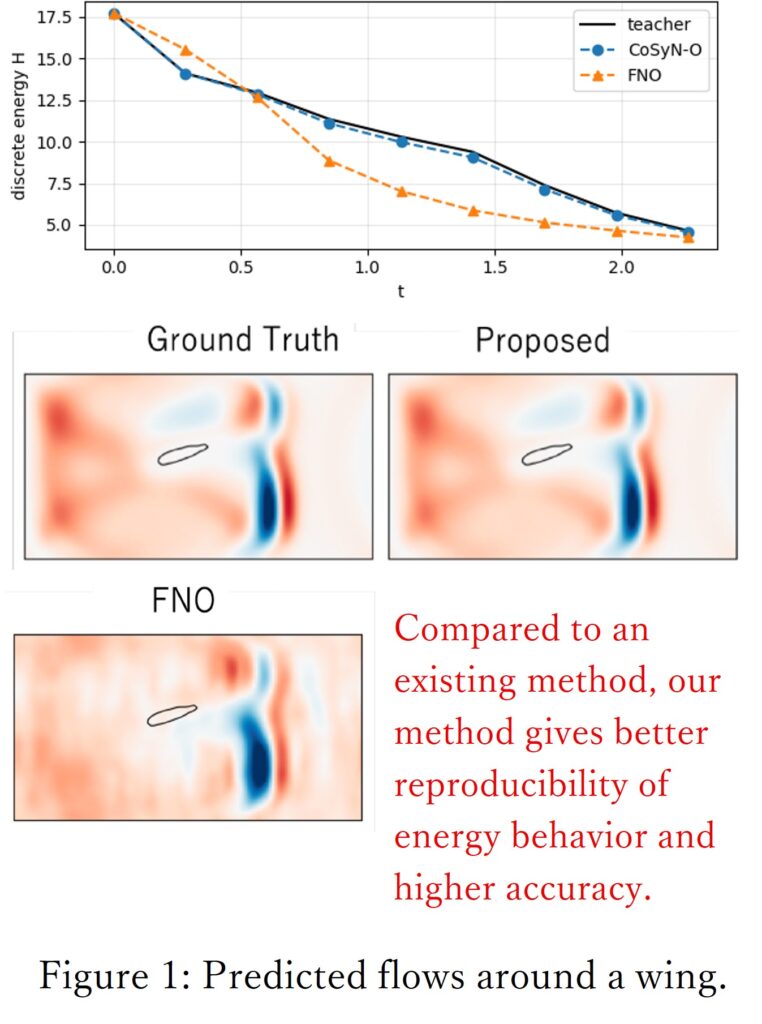
energy conservation stem from the geometric properties of the equations. Designing machine learning methods to preserve geometric properties often significantly improves their accuracy and stability. Figure 1 illustrates an example of such a method. This method utilizes the fact that classical mechanical systems with dissipative terms such as friction are characterized by a property known as conformal symplecticity and is designed to preserves this property. The method is applied to predict the flow field around an airfoil. The results confirm that predictions are of very high accuracy compared to conventional methods.