

Representation theory of Lie groups and Fourier transform
Masatoshi KITAGAWA
Degree: PhD (Mathematical Science) (the University of Tokyo)
Research interests: Lie Group, Representation Theory
I specialize in a field called representation theory of Lie groups. When I say that my field is “representation theory,” people sometimes mistake it for something in the literary studies, but it is in fact a well-established branch of mathematics. For example, the Fourier transform, which is also important in applications, is a basic example of representation theory.
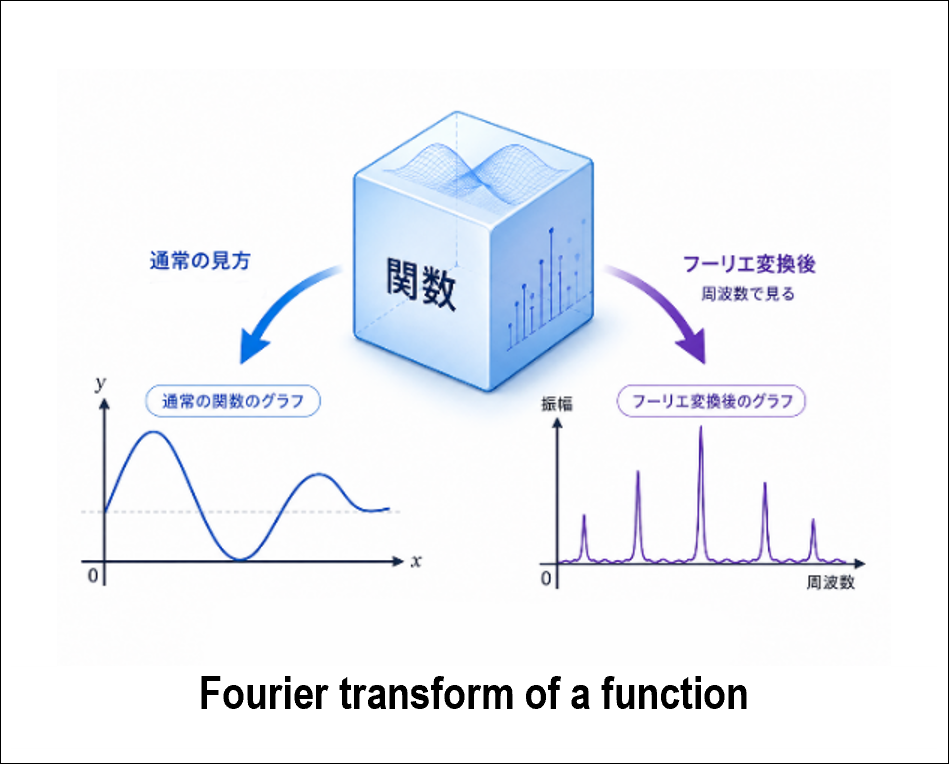
The Fourier transform converts a function into another function that describes how much of each frequency component is contained in the original function. The Fourier transform has many useful properties, but here I would like to focus on its relationship with translations.
To translate a function means to translate its graph. Translating a graph changes only its position, not its shape. On the other hand, if we look only at the value at a particular point, it can change greatly. In other words, from a macroscopic point of view the function may not seem to have changed much, while from a microscopic point of view it may have changed significantly. If we first translate a function and then take its Fourier transform, the result is the same as first taking the Fourier transform and then multiplying it by an exponential function. Multiplication by a function is an operation performed point by point, so in this setting the operation becomes very simple at the microscopic level. In this way, the Fourier transform can be regarded as a device that converts a geometric transformation, namely translation, into a pointwise operation, namely multiplication by a function.
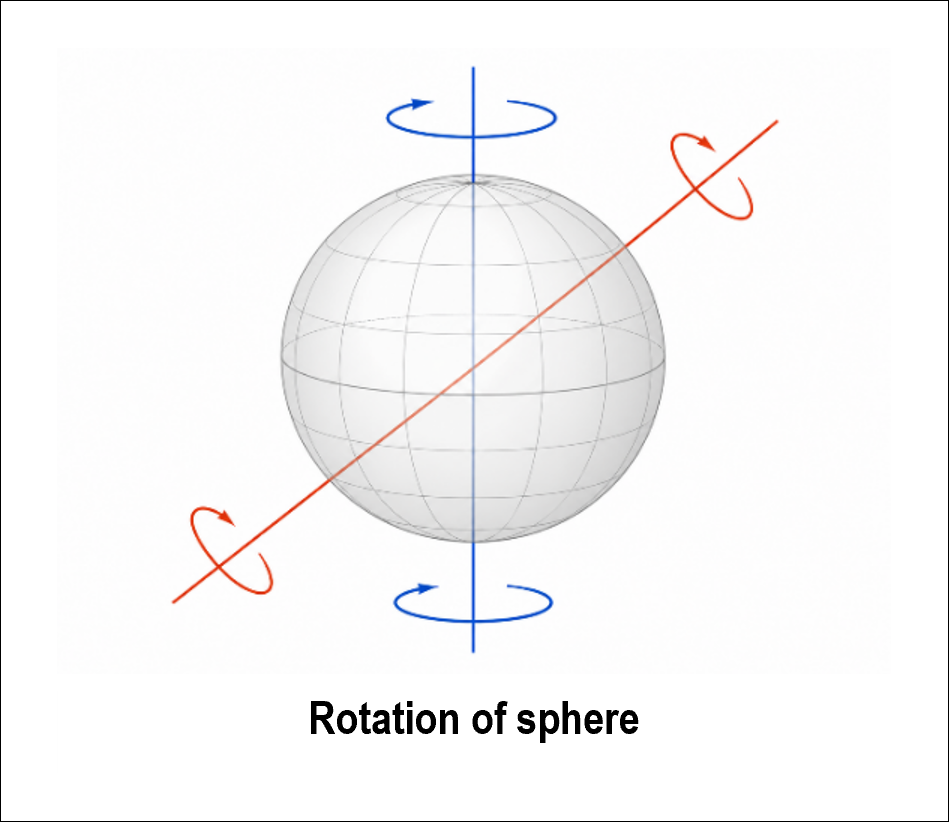
Translation is a symmetry of the number line. If we replace the number line by a circle and translation by rotation, and then consider an analogous operation to the Fourier transform, we obtain the Fourier series expansion. This idea naturally extends to shapes (manifolds), and their symmetries (group actions). For example, one may consider a sphere together with rotations, or the set of vertices of a regular polygon together with rotations. Each case gives rise to a different transform; in particular, the latter is called the discrete Fourier transform.
Just as translations of functions are associated with the number line, when a shape has a group action, the same group action is induced on the vector space consisting of all functions on that shape. A vector space equipped with such a group action is called a representation of the group.
However, not every kind of symmetry gives rise to a useful transform. My research is concerned with what conditions are needed in order to obtain good transforms, and how such transforms can be described explicitly.
Now, one might think that representation theory of groups cannot be used when there is no symmetry, but that is not necessarily the case. For example, when analyzing finite data such as images or audio, one periodically extends the finite data and then applies the Fourier transform. This kind of operation is also used in Shor’s algorithm, a quantum-computer algorithm for integer factorization. In that algorithm, data whose period is unknown is forcibly converted into data whose period is a power of two, which is easier for a computer to handle, and the Fourier transform is then applied in order to estimate the period of the original data. In this application, the Fourier transform is used for the purpose of ignoring shifts caused by translations.
There are also methods in which objects without symmetry are embedded into representations so that representation theory can be applied. Thus, regardless of whether symmetry is present, representation theory is expected to have applications in a wide range of fields.
I am currently participating in a project on mathematics education for quantum information. Quantum information is a field that is highly compatible with representation theory, and I have been able to make use of my previous research experience. Going forward, I hope to continue my research in representation theory while also applying that experience to fields such as quantum information.