
Analytic number theory and seals

Karin IKEDA
Degree: PhD (Mathematical Science) (Kyushu University)
Research interests: Number theory, Analytic number theory, Probabilistic number theory
My research area is number theory, in particular number theory using analytic methods. I have conducted research using various analytic methods. In my previous research, I have studied a wide range of objects in number theory, including functions defined as generalizations of the Riemann zeta function, as well as the partition function, the Goldbach representation, and the elliptic modular j-function.
First, the Riemann zeta function is a function well known for its connection to the Riemann Hypothesis, an unsolved problem that has remained open for over 160 years, and it is an important object in number theory as it contains information about the distribution of prime numbers. I have studied several generalizations and variants of the Riemann zeta function, including multiple zeta values, which generalize its special values at positive integers; the Hurwitz zeta function, which adds a real parameter; and a Hurwitz-type central binomial series, obtained by adding a parameter to a central binomial series with binomial coefficients in the denominator. For these objects, I have carried out research using complex analysis; for example, I have studied the uniqueness of real zeros in a certain interval and properties of special values. I have also studied the Goldbach representation, which can be regarded as a quantitative version of the Goldbach conjecture (which states that every even integer greater than or equal to 4 can be expressed as the sum of two prime numbers).
Furthermore, I have used not only complex analysis but also probability theory, a branch of analysis, to derive asymptotic formulas for generalized partition functions with congruence conditions, and to give an alternative proof of the asymptotic formula for the Fourier coefficients of the elliptic modular j-function.
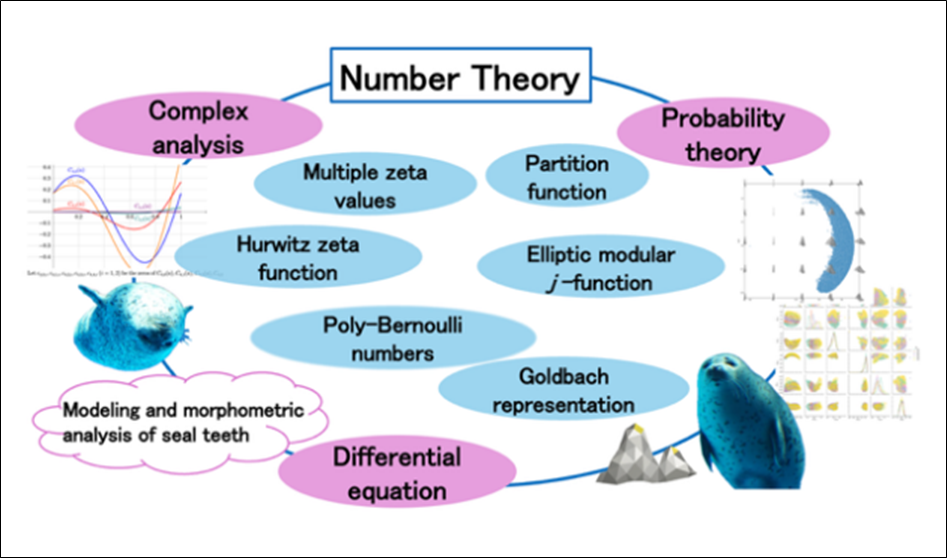
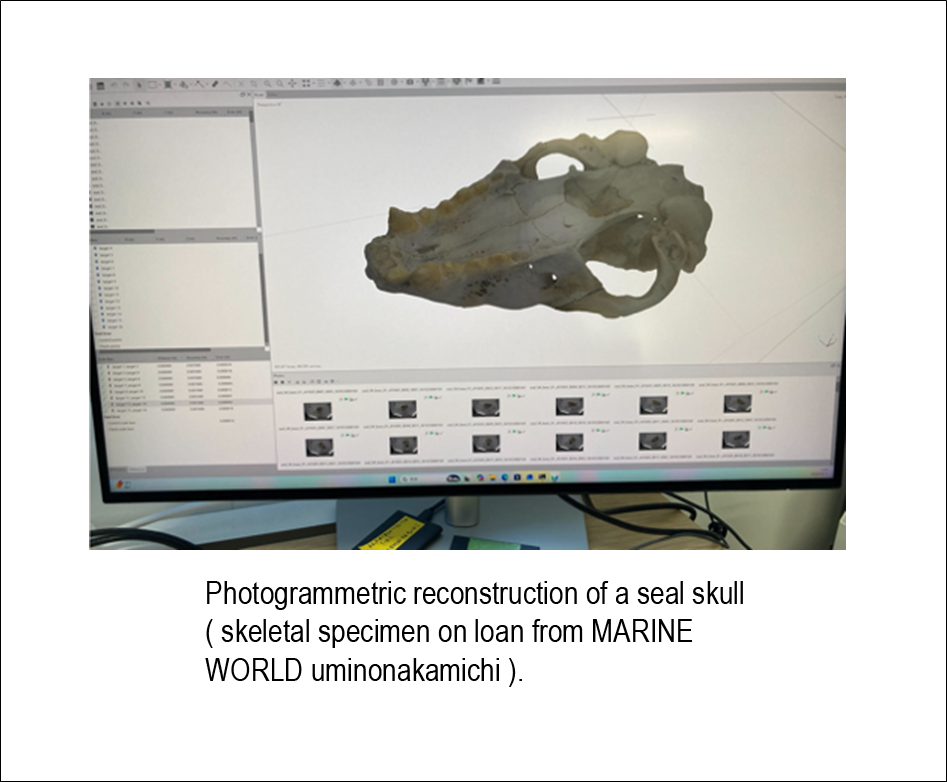
In addition to my work in number theory, I am working on a project on “Modeling and morphometric analysis of seal teeth” in a mathematical biology laboratory, with the aim of investigating the relationship between genotype and phenotype spaces and developing a deeper understanding of evolutionary dynamics. I would like to work toward building a better theoretical framework for outline-based morphometrics used in the analysis, by applying objects and methods from number theory that I encounter in my research.