
Gröbner Basis
Ryoya FUKASAKU
Degree:
Research interests: Computer, Algebra
For instance, systems of linear equations can be solved based on Gaussian elimination. Since systems of algebraic equations consist of multivariate polynomials, they can be viewed as a generalization of linear systems. Consequently, Gröbner bases—including the underlying methodology—represent a generalization of Gaussian elimination.
By utilizing Gröbner bases, it is possible to exactly compute all solutions to a system of algebraic equations. For example, numerical methods such as Newton’s method often struggle to find all solutions of a system with complete precision. In contrast, Gröbner bases enable us to do so.
Gröbner bases were not originally proposed as a tool for finding all exact solutions to systems of algebraic equations. Rather, they were introduced as a means to determine a canonical representative (normal form) within the quotient ring of an ideal in a multivariate polynomial ring.”
By leveraging the ‘favorable properties’ of Gröbner bases within quotient rings, I have improved the computational efficiency of a tool known as Quantifier Elimination (QE). This tool computes a quantifier-free formula that is equivalent to a given first-order predicate formula over the real field. For example, when we have the first order formula

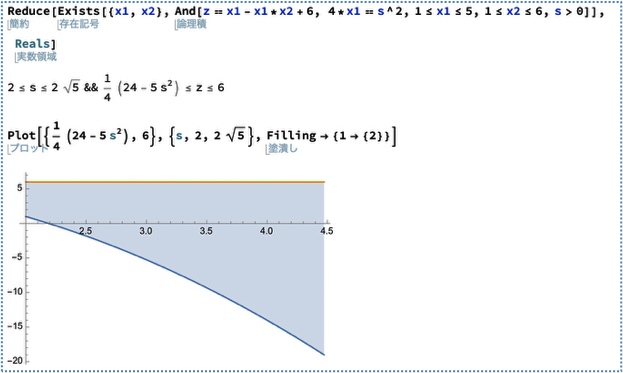
QE return the formula a2 – 4b ≥ 0. As a result, this method also enables symbolic optimization. For example, when we have


, we introduce a new parameter z, and we consider the first order formula



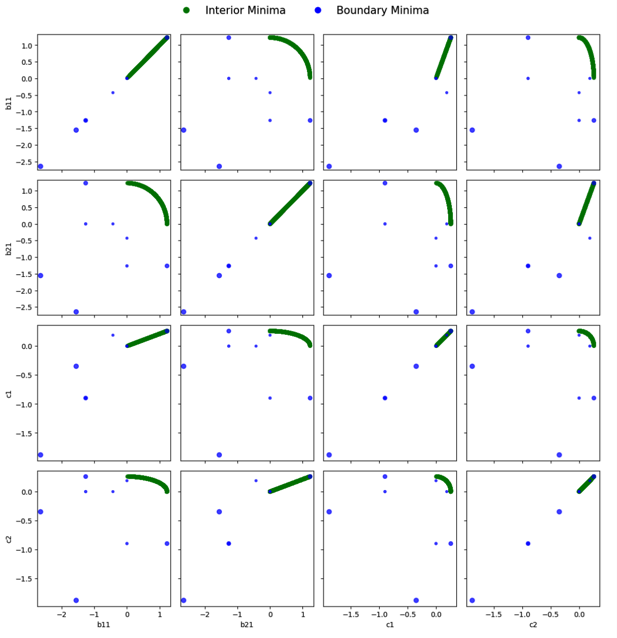
As shown in the screenshot of the Mathematica package Reduce, quantifier elimination is a versatile method for the real field that achieves optimization while preserving symbolic parameters. Recently, I have also been working on applying computer algebra to mathematical statistical models, such as factor analysis and neural networks. The output below illustrates the locations of the stationary
points for the Mean Squared Error (MSE) of a neural network. As demonstrated, Gröbner bases allow us to rigorously determine whether the stationary point equilibrium consists of curves or other geometric structures.