

Euler number and magnitude

Yasuhiko ASAO
Degree: PhD (University of Tokyo)
Research interests: Magnitude Theory, Algebraic Topology
Topology can be described as a general term for mathematical methods that measure “how things are connected.” But what does it mean to measure connectedness?
When we look at an object in front of us, we know many ways to measure its size. We can measure its length, weight, volume, or number of components—the list goes on. Even for length alone, there are different systems of measurement, such as meters and yards. Yet the characteristics of an object are not limited to its size. It may also have color, texture, or smell. Over time, humanity has developed units and scales to quantify these various features.
One such feature is “connectedness” and its degree. In other words, we ask how the elements that make up an object are connected to one another to form the whole. Remarkably, this pattern of connections can be expressed as a number. Moreover, there is not just one way to do this. Just as there are different units for length, mathematicians have developed many different methods for measuring connectedness.
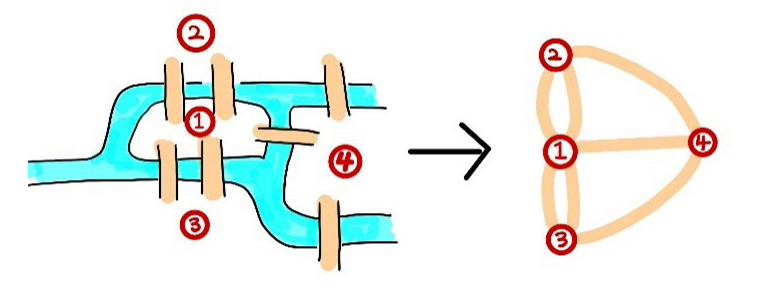
A famous example of solving a problem by “measuring connectedness” dates back to the early 18th century. The question was whether it was possible to cross each of the seven bridges in the town of Königsberg exactly once, without crossing any bridge twice. If you try to trace possible routes on a drawing of the bridges, you will find that the problem reduces to determining whether the corresponding graph can be drawn in a single stroke without lifting your pen. In fact, this graph cannot be drawn in such a way. The great mathematician Leonhard Euler proved this by expressing the graph’s pattern of connections as a number. After solving this problem, Euler introduced a number measuring connectedness so called the Euler characteristic.
Let us examine the structure of this solution. First, from the picture of the bridges, we extract a “skeleton” in the form of a graph. Then we express the connectedness of this graph using numbers, thereby translating the original question into a problem about numbers. This general scheme for solving problems is still widely used in modern geometry. From a space we wish to analyze, we extract a skeletal object X, and we measure the connectedness of X using the Euler characteristic. Today, however, instead of graphs, mathematicians often use objects called categories. Likewise, the Euler characteristic has been replaced in many contexts by more sophisticated tools known as homology and homotopy. These different methods are deeply related to one another, much as different units of length are compatible through conversion.
In the discussion above, we extracted a category as a kind of skeleton of a space. In fact, it has become clear that by slightly strengthening the notion of a category, one can represent the space itself. This strengthened notion is called an enriched category. An enriched category is obtained by adding one ingredient to an ordinary category. Depending on the type of ingredient we choose, we obtain different kinds of enriched categories. One important example is a metric space. For instance, any subset of Euclidean space is a metric space. Thus, such familiar spaces turn out to belong to the same conceptual family as categories.
Just as we can compute the Euler characteristic or similar invariants from a category, we can also extract numerical quantities expressing connectedness from a metric space. In the early 2000s, the mathematician Tom Leinster introduced such a quantity and called it magnitude. Since it was proposed only about twenty years ago, it is still a relatively new concept in mathematics. Its properties, efficient methods of computation, and possible applications are currently being actively explored, making it a highly attractive area of research. My work aims to develop and deepen the foundational theory of this new “method of measuring connectedness,” while also exploring ways to apply it to industrial and real-world problems.