
Aiming at nontrivial targets with theta function
Shota SHIGETOMI
Degree: PhD(Functional Mathematics)(Kyushu University)
Research interests: Integrable Systems, Discrete Differential Geometry, Applied Physics, Theta Function
I study (1) integrable systems and related geometry and (2) applied physics, with a focus on elliptic theta functions. Elliptic theta functions are known for their rich mathematical properties and appear in a wide range of mathematical fields. In the case of my research, these properties are used to construct exact solutions to integrable systems. They are also important for discretizing equations from the information contained in the solutions and for discovering nontrivial conserved quantities. Below are some examples of applications of theta functions with specific examples.
(1) Integrable systems and related geometry:
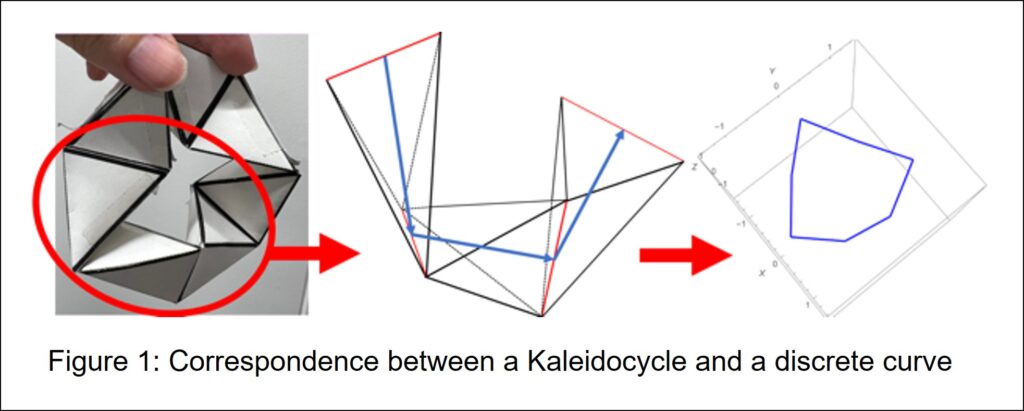
Integrable systems are a family of differential equations whose exact solutions can be constructed using well-known functions, despite their nonlinearity. Integrable systems have various applications, but among them, the study of discrete curves and surfaces is particularly important, as it applies to fields of high industrial practicality, such as computer graphics, architecture, and linkage mechanisms. One example is the Kaleidocycle, a linkage mechanism formed by connecting congruent tetrahedra in a ring by hinges, which deforms like a bubble ring. The Möbius Kaleidocycle, in particular, is of great mathematical, physical, and engineering interest, having a single degree of freedom of deformation and multiple conserved quantities, though rigorous analysis of linkages is generally difficult. However, viewing the mechanism as a discrete curve (Figure 1) reveals that its deformation can be described by an integrable system, with the curve’s position vector explicitly constructible using theta functions. These results have led to a rigorous proof that a Kaleidocycle can always be constructed with six or more tetrahedra, as well as the discovery of previously unknown conserved quantities.
(2) Applied physics:
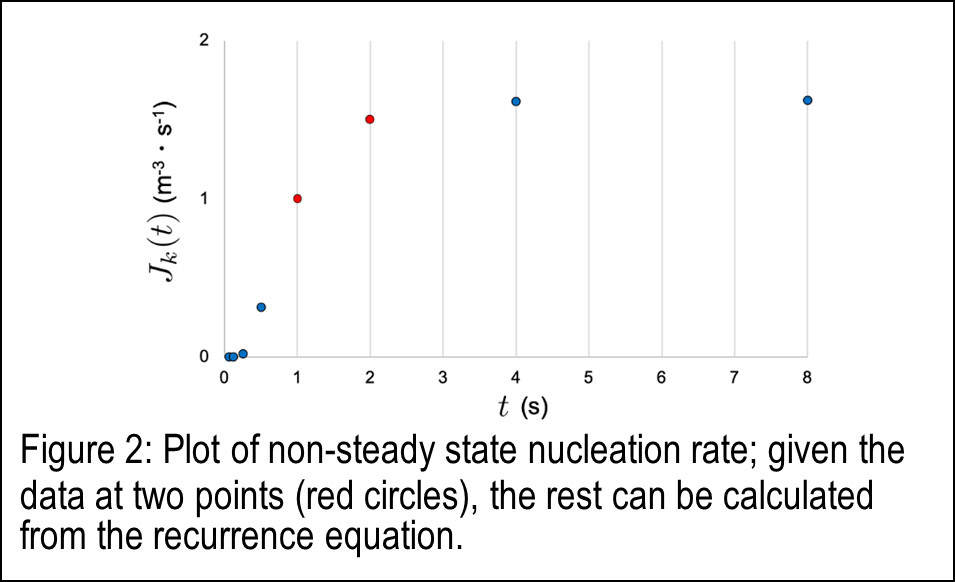
Theta functions also appear in physics, and I have been using them to study phenomena in applied physics. Non-steady state nucleation is a phenomenon such as that seen in the initial stage of vesiculation of carbonate water, which can be observed in daily life. This phenomenon is characterized by a quantity called the non-steady state nucleation rate Jk( t ). Measuring this quantity may require a long experiment, which presents a cost challenge. On the other hand, it was pointed out in 1969 that Jk( t ) is expressed by an elliptic theta function, but since its publication, there were no research utilizing the properties of theta function. In this study, nontrivial recurrence equations satisfied by Jk( 2nt ) were derived using the properties of theta functions, allowing the value of Jk( t ) to be estimated with a small amount of data (Fig. 2). The results can be used to reduce costs in experimental studies of non-steady state nucleation.