

Solving social problems and mathematical systems approaches
HIrokazu ANAI
Degree: PhD (Information Science and Technology) (The University of Tokyo)
Research interests: Social Math, Computer Algebra, Mathematical Optimization Artificial Intelligence
In recent years, the use of mathematics, data science, and AI has become increasingly important in solving problems and creating value in industry and society.
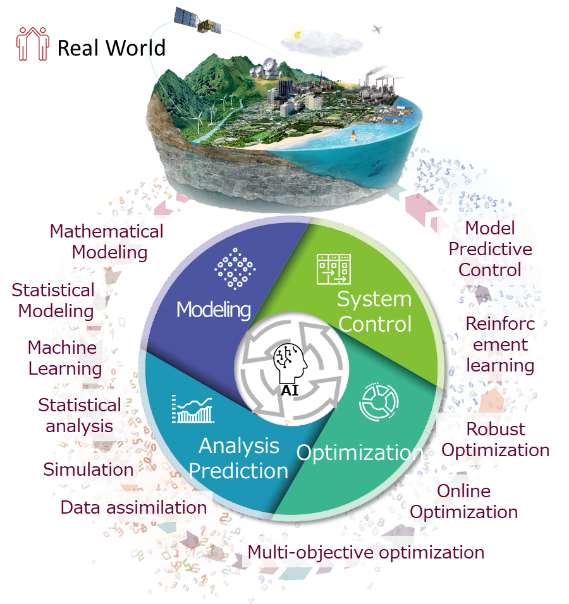
I have been engaged in research and development of solutions that combine cutting-edge mathematical technologies (mathematical modeling, computational algebra, optimization, system control theory, etc.) with artificial intelligence (AI) such as machine learning to solve various issues facing industry and society.
For example, we focused on the usefulness and potential of Groebner base and quantifier elimination (QE), which are algorithms for solving algebraic constraints and promoted research on their application to practical problems. QE can handle non-convex and nonlinearity, and we have tried to resolve the problems that are difficult to deal with numerical methods. Then we applied to control system design problems required in the manufacturing of automobile engines, HDDs, analog circuit design etc.
In solving social issues, we established and conducted joint research on mathematical technology to realize systems and measures for a fair and acceptable society at IMI’s Fujitsu Social Mathematics Joint Research Division (2014~2017). We worked on matching the destination of immigrants who wished to move to (Itoshima City), and based on the results of this department, we developed other activities such as security planning. We believe that research in this area will be an important technology for the design of coordination, negotiation, and optimization in the future world of AI agents.
Through such R&D and social implementation, we realize the importance of connecting theory and practice, aiming to solve specific problems and create new values. The approach to this is the mathematical systems approach.
We are always pursuing innovation in mathematical technology, which is essential for realizing this, and are interested in creating concrete paths and innovative ideas that connect difficult mathematical models to the needs of the real world.
Based on his research on computational algebraic algorithms, he has also been working on the automatic solving of mathematical problems by fusing with natural language processing. Since 2012, we worked on the mathematics team of the National Institute of Informatics (NII) project “Can robots enter the University of Tokyo?” and developed an AI that solves mathematical problems written in natural language and achieved a deviation of 76.2 in the mathematics of the 2nd mock exam at the University of Tokyo in 2016. Since then, the ability to solve mathematical problems has also advanced at an overwhelming speed in response to the dramatic progress of current generative AI. The impact of this progress in AI for Math research on industry and society is significant, and I am deeply interested in the possibilities it brings to mathematics and science, as well as industry.